Running a solo business means wearing every hat—marketing, operations, content, client work, and admin. AI can help, but only if the tools actually save time and don’t turn into another monthly expense you regret. After testing dozens of platforms across writing, automation, design, and business ops, this is the leanest AI stack I’d recommend to solopreneurs who want real leverage without bloated costs. No hype—just tools that earn their place.
What This AI Stack Is Designed to Do
This setup focuses on three priorities most AI stack solopreneurs share:
- Increase output without increasing working hours
- Replace multiple tools with fewer, smarter ones
- Keep monthly costs predictable and reasonable
It’s not about chasing every new AI product—it’s about building a stack that quietly works in the background.
1. ChatGPT – The Core Brain of the Stack
If I had to keep only one AI tool, this would be it.
ChatGPT functions as a writing assistant, strategist, research aide, and workflow partner. For solopreneurs, the real value isn’t just content creation—it’s thinking faster and more clearly.
Real-World Use Cases
- Drafting blog posts, emails, proposals, and scripts
- Brainstorming offers, headlines, and positioning
- Simplifying complex ideas for clients or audiences
- Creating SOPs and internal documentation
Strengths
- Replaces multiple writing and ideation tools
- Flexible across industries and business models
- Improves with better prompts and context
Limitations
- Requires human judgment and editing
- Not a replacement for deep domain expertise
Why it stays in the stack:
It reduces cognitive load. Instead of starting from zero, you start from clarity.
2. Notion AI – Planning, Documentation, and Systems
Notion AI shines when you’re managing ideas, projects, and long-term assets, not just generating text.
Used correctly, it becomes your second brain.
Real-World Use Cases
- Organizing content calendars and client projects
- Turning messy notes into structured documents
- Summarizing meetings, research, or brainstorms
- Managing personal knowledge and SOPs
Strengths
- Combines workspace + AI in one tool
- Excellent for long-term organization
- Reduces tool switching
Limitations
- AI output isn’t as nuanced as ChatGPT
- Can feel overwhelming without a simple setup
Why it stays in the stack:
It helps solopreneurs stay organized as they scale—without hiring help too early.
3. Canva (with AI Features) – Visuals Without a Designer
Visual content matters, but most solopreneurs don’t need Photoshop-level complexity. Canva’s AI tools make design faster without sacrificing quality.
Real-World Use Cases
- Social media graphics and carousels
- Lead magnets and PDFs
- Thumbnails, brand visuals, and presentations
Strengths
- Extremely beginner-friendly
- AI-assisted layouts and copy suggestions
- Strong templates for business use
Limitations
- Less control for advanced designers
- Overused templates need customization
Why it stays in the stack:
It replaces outsourcing for 80% of everyday design needs.
4. Zapier (or Make) – Automation That Pays for Itself
Automation is where solopreneurs quietly win back hours every week.
Zapier connects your tools so tasks happen automatically—without technical headaches.
Real-World Use Cases
- Auto-adding leads to CRM or email lists
- Connecting forms, calendars, and notifications
- Triggering workflows from simple actions
Strengths
- Huge app ecosystem
- No-code setup
- Reliable once configured
Limitations
- Costs can increase with heavy usage
- Requires initial setup time
Why it stays in the stack:
One good automation often saves more time than any AI writing tool.
5. Grammarly or Hemingway – Final Polish
AI-generated content still needs a human touch. These tools help clean up clarity, tone, and readability before publishing or sending to clients.
Strengths
- Fast quality improvement
- Helpful for non-native writers
- Minimal learning curve
Limitations
- Not necessary for very short content
- Can over-simplify if overused
Why it stays in the stack:
It protects credibility—especially in client-facing work.
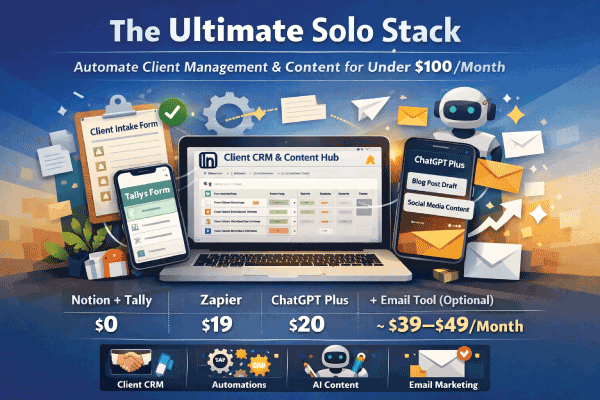
Estimated Monthly Cost (Lean Setup)
Depending on plans and usage, most solopreneurs can run this entire stack for far less than hiring one freelancer for a single task.
More importantly, each tool replaces multiple roles—not just one function.
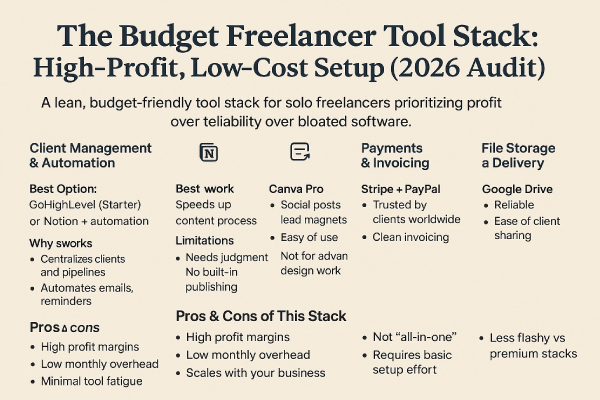
Pros and Cons of This AI Stack
Pros
- Covers content, planning, design, and automation
- Scales with your business
- Low learning curve
- Strong ROI for solo operators
Cons
- Requires discipline to avoid tool overload
- AI still needs human oversight
- Best results come from consistent use
Who This Stack Is Best For
- Freelancers and consultants
- Content creators and bloggers
- Solo founders and digital product builders
- Anyone running a one-person business on a budget
If you rely heavily on thinking, writing, planning, or managing workflows, this setup fits naturally.